
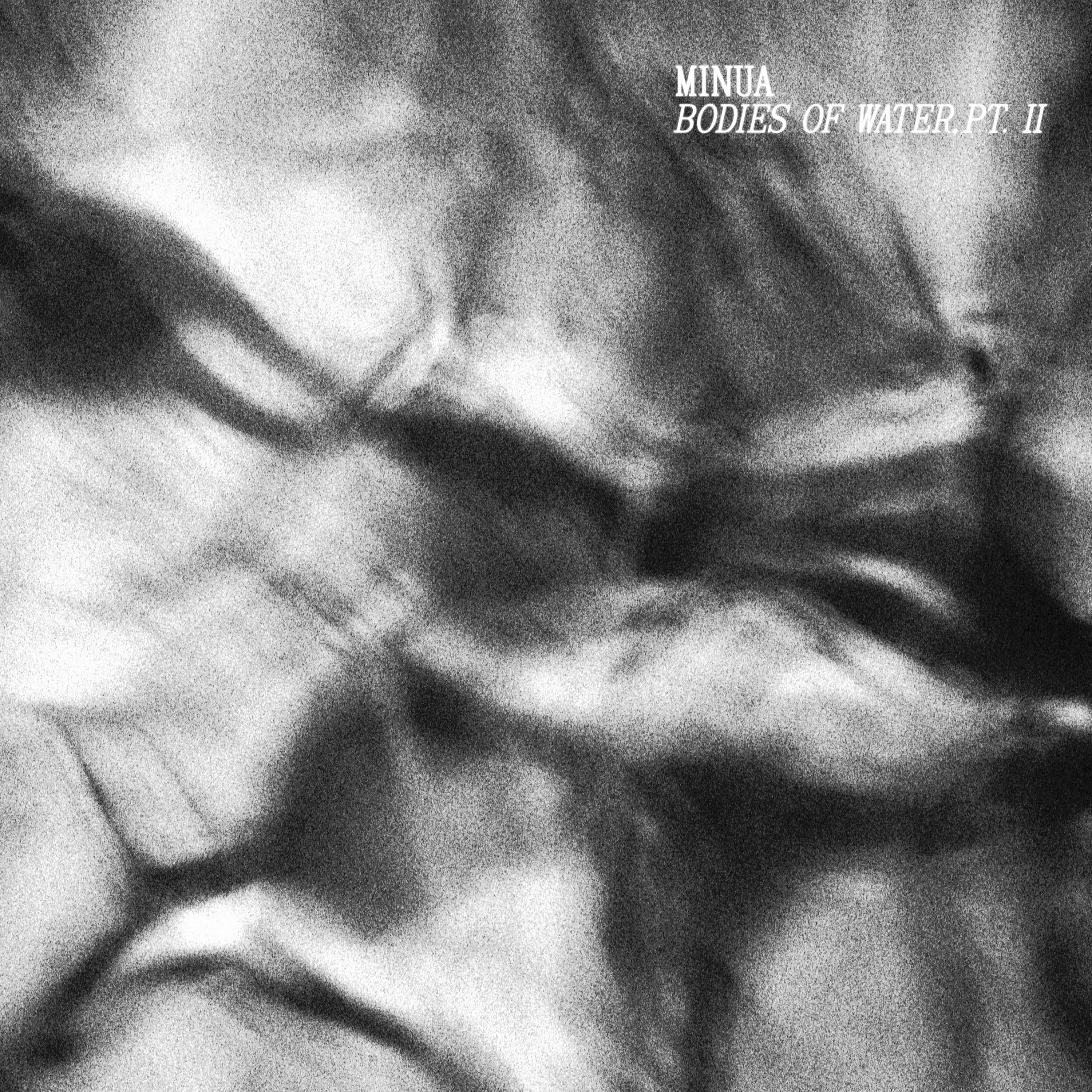
Bodies of Water, Pt. II by Minua
Levee moves with quiet determination, propelled by a pipe-toned synth that presses forward while the bowed tones of the sarangi hover somewhere between background and foreground. It’s hard to know which is which. Melodies heard before return in fragments, but the landscape around them is altered. The piece feels fragile, on the verge of collapse, like a levee holding back more than it can bear.
In Rapids, the shruti box and sarangi return, setting the tone alongside bass clarinet and the serpentino—a rarely heard 16th-century brass instrument with a sinuous, voice-like character, played here by Raphaël Rossé. A slow canon begins to take shape, but the texture is soon pierced by a bell-like synthesizer that arrives with urgency. The sarangi sings and weeps above the increasingly insistent synth, which begins to cut through the mix like light through a stormcloud. The sound grows unstable, noisier, harder to contain. By the end, the piece leaves a strange feeling of emptiness—unsettled and unresolved.
Inlet explores contrast through convergence. Delicate guitar picking, both acoustic and electric, flows beside long, low tones, their interaction shifting between motion and pause. Clarinet (not bass this time) joins the guitar textures, while the euphonium sketches a broken, wandering melody. The piece recalls the band’s earlier sound world, but with more space, more time, more quiet.
A shift occurs in Rivulet, where the music briefly takes on a song-like shape. A strong yet gentle guitar pattern anchors the piece, giving it the feel of a voice. This is familiar ground for Minua, though the recurring motif—now moving faster—feels revitalized. Toward the end, Fabian and Raphaël improvise freely over the guitar's steady patterns. Their lines are fluid, bright, and unforced, like water running over stone.
Kvísl continues in this terrain, beginning with a bright guitar pattern that soon finds itself doubled by bass clarinet and euphonium. The melody seems locked within the guitar’s structure until, gradually, the horns break free and drift outward. There’s a sense of release here, of something long held finally moving again.
The album closes with Lacunae, a piece that begins in absolute simplicity: a pure sine wave in slow duophony. Voices slowly gather, filling the frequency spectrum with rich overtones before falling away again, returning to the bare tone from which they began. There’s something quietly redemptive in this arc. Lacunae leaves the listener in a state of suspended openness—hopeful, but tinged with melancholy. A gentle conclusion to a work shaped by time, texture, and the pull of current.
credits
Kristinn Kristinsson – electric guitar, synthesis
Luka Aron – acoustic guitar, modular synthesizer
Fabian Willmann – bass clarinet, clarinet
Raphael Rossé - euphonium, serpentino
All compositions by Kristinn Kristinsson except Lanunae by Luka Aron
Recorded by Adam Asnan.
Mixed by Kristinn Kristinsson.
Mastered by Luka Aron.
Cover photography by Kristinn Kristinsson.
Graphic Design by Luka Aron.
© 2025 Hout Record